German Government: Human Rights in Egypt deteriorating

Today the Federal Government of Germany published its annual report on its human rights policy. It is the 14th time Germany has presented its views and its knowledge about the status of human rights in the world. The Federal Government Commissioner for Human Rights Policy and Humanitarian Assistance, Bärbel Kofler, presented the 303 pages thick report at a federal press conference in Berlin.
In the last 50 pages of the report, the German Foreign Office presents its assessment of the human rights situation in 28 countries around the world, from Egypt to the Central African Republic.

Regarding Egypt, Germany’s Foreign Office finds little to nothing to applaud. The human rights situation has deteriorated even more since the last report, there are arbitrary arrests, detention without charge, trials that do not meet the rule of law criteria and death sentences, cases of torture, enforced disappearances and ill-treatment in police custody. In addition, overcrowded prisons pose an acute threat to detainees due to the COVID 19 pandemic.

The report points out that Egypt has ratified eight of the nine key UN human rights conventions and that the Egyptian Constitution and Egypt’s international commitments provide for extensive protection of fundamental and human rights. Germany’s government however comes to a bitter conclusion: “In practice this is of little importance.”

Read here the complete report on human rights in Egypt by the German Foreign Office:

————————————————

14th Report of the Federal Government of Germany on its human rights policy

Egypt

Development of the human rights situation during the reporting period

The human rights situation in Egypt has continued to deteriorate. The balance of power continues to shift in favour of the President. The imposition of a state of emergency in 2017 was followed by a constitutional amendment in 2019, which grants the executive branch extensive rights of control over the judiciary. The new Emergency Law provides the President with further extensive powers. Freedom of expression, press, assembly and association are not guaranteed. There are arbitrary arrests, detention without charge, trials that do not meet the rule of law criteria and sometimes death sentences. There are also cases of torture, enforced disappearances and ill-treatment in police custody. Following protests in September 2019, mass arrests of at least 4000 people were made. According to human rights organisations, thousands of people are being held in Egyptian prisons under unacceptable conditions for political reasons. In addition, overcrowded prisons pose an acute threat to detainees due to the COVID 19 pandemic.

Existing laws to protect minorities are often not enforced. Women and children become victims of human trafficking for the purpose of forced marriage and forced labour despite legal prohibition. A draft law against domestic violence has failed. The prohibited genital mutilation continues to be widespread. There are indications of organised illegal organ trafficking, which particularly affects refugees.

Basic services for the population (access to water, food, health) are guaranteed, but at a low level despite state subsidies. The World Bank assumes that 60 percent of the population is poor or at risk of poverty. Cultural rights are restricted in practice.

Implementation of human rights obligations / human rights policy

Egypt has ratified eight of the nine key UN human rights conventions. The Egyptian Constitution and Egypt’s international commitments provide for extensive protection of fundamental and human rights, but in practice this is of little importance. The government and the state media often portray human rights and due process as obstacles to stability and the fight against terrorism.

Examples of German and European project work

Through its project work, Germany is particularly active in the area of support for human rights defenders and participates in process monitoring. Within the framework of development cooperation, we support the National Human Rights Council in Egypt. In 2019, the Franco-German Human Rights Prize was awarded for the third time in a row to Egyptian prizewinners (El-Nadeem Centre for the Rehabilitation of Victims of Violence and Torture).

––––––––––––––––
Source: 14th Report of the Federal Government of Germany on its human rights policy – reporting period 1 October 2018 to 30 September 2020
Original document (German) – Report on Egypt on page 256/257:
https://www.auswaertiges-amt.de/blob/2422192/f01891c5efa5d6d89df7a5693eab5c9a/201202-mrb-14-download-data.pdf

‪Global Journalist: Egypt’s staged election‬

Global Journalist March 8, 2018Egypt will hold a presidential election at the end of this month. But there’s little drama about who will actually win.
President Abdel-Fatah el-Sissi, who led a 2013 coup against the country’s first democratically elected leader, is expected to be handily re-elected. That’s because el-Sissi’s government has arrested or intimidated all viable potential opponents.

That’s left him facing off against one virtually unknown opponent – someone who was actually an outspoken supporter of el-Sissi until just hours before the candidate registration deadline.

So while most observers view this election as a sham – it’s not without drama. After el-Sissi’s coup ended a brief experiment with democracy following the Arab Spring, the country has been going backwards in many ways.

Its economy is stagnant, its population is growing rapidly and there’s virtually no place for people to express discontent. Opposition leaders have been jailed or exiled and independent media has been tightly restricted. Meanwhile the country faces a bloody Islamist insurgency in the Sinai peninsula.

Critics say things are worse even than under former President Hosni Mubarak, who was ousted by street protests in 2011.

On this edition of Global Journalist a look at Egypt’s staged election, and what it may mean for its future and its relationship with the U.S

Joining the program:

*Michele Dunne, director of the Middle East program at the Carnegie Endowment for International Peace

*Sara Khorshid, an Egyptian journalist who has written for Foreign Policy and the New York Times

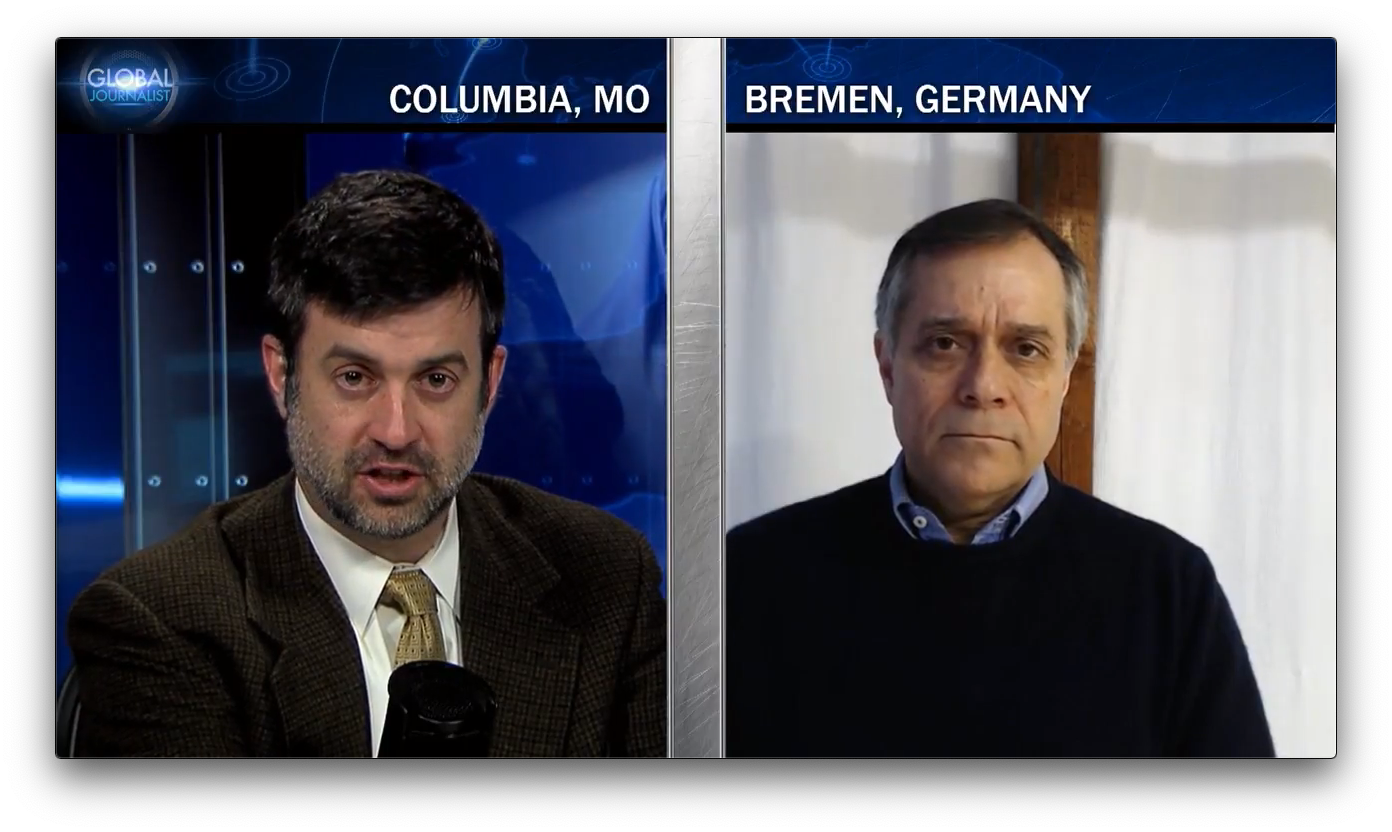
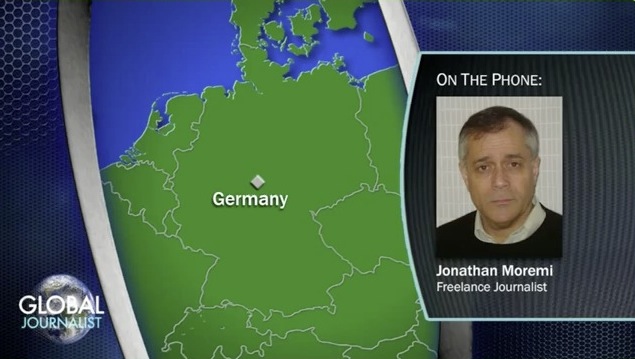
*Jonathan Moremi, an international correspondent who has written for The Daily News Egypt

*Stephen Zunes, professor of politics and international relations and coordinator of the Middle East program at the University of San Francisco

Watch …


‪Global Journalist: Egypt in crisis?‬

Global screen grabIt’s been two years since the Egyptian military ousted democratically-elected President Mohammed Morsi, replacing him with Army General Abdel Fattah Al-Sisi.

 Al-Sisi has promised stability but his time as president has been anything but peaceful. Violence still rages throughout parts of the country, and reporters are being thrown in jail simply for doing their job.

On this edition of Global Journalist, we look at how the country has arrived at this point, and where it’s going in the future.

Our guests this week:

*Stephen Zunes, a professor of politics and the coordinator of Middle Eastern Studies at the University of San Francisco

*Jonathan Moremi, a journalist who’s covered the country for more than 35 years for outlets including Daily News Egypt

*Adel Iskander, a professor of communication at Simon Fraser University in Vancouver and co-editor of the Arab Studies

*Emir Nader, a political reporter for Daily News Egypt

Watch …

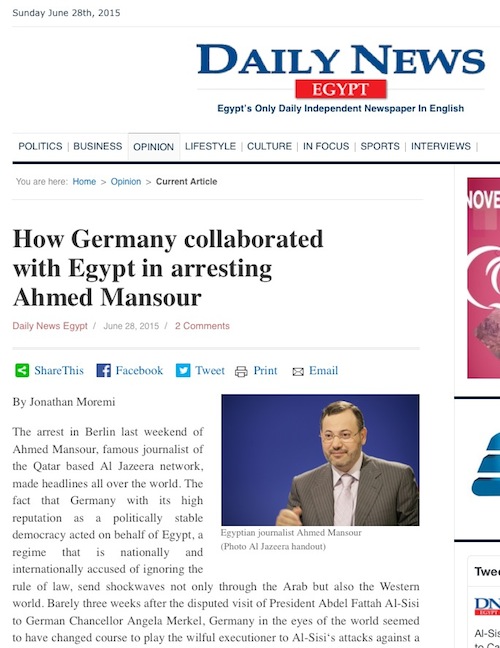
How Germany collaborated with Egypt in arresting Ahmed Mansour

DNE Mansour titleThe arrest in Berlin last weekend of Ahmed Mansour, famous journalist of the Qatar based Al Jazeera network, made headlines all over the world. The fact that Germany with its high reputation as a politically stable democracy acted on behalf of Egypt, a regime that is nationally and internationally accused of ignoring the rule of law, send shockwaves not only through the Arab but also the Western world. Barely three weeks after the disputed visit of President Abdel Fattah Al-Sisi to German Chancellor Angela Merkel, Germany in the eyes of the world seemed to have changed course to play the wilful executioner to Al-Sisi‘s attacks against a free press.

Read more …

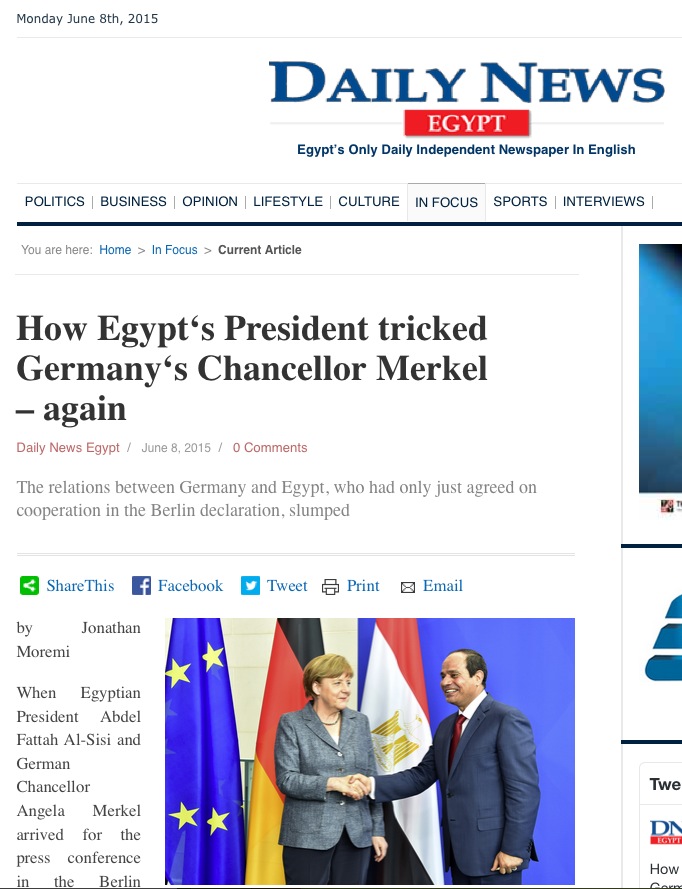
NGO trial: How Egypt‘s President tricked Germany‘s Chancellor Merkel – again

DNE NGO articleWhen Egyptian President Abdel Fattah Al-Sisi and German Chancellor Angela Merkel arrived for the press conference in the Berlin chancellery last week, they were late. “We had a little delay,” apologised the Chancellor, “we had a problem with the elevator. We went up and down several times but finally, with the help of the second elevator, in the end managed to be here.” President Al-Sisi wore a broad grin on his face.

The symbolism of this was not lost on the political observer. For decades, from President Nasser to Sadat and Mubarak, the interim government under SCAF, President Morsi and now Al-Sisi, the relationship between Egypt and Germany has been constantly going up and down, and a chance to find the second elevator to finally reach a mutual position has so far not emerged.

Read more …

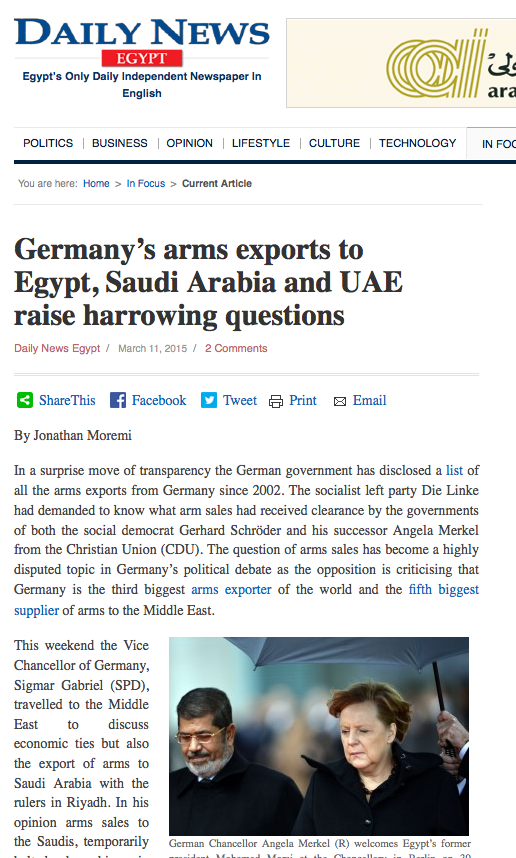
Germany’s arms exports to Egypt, Saudi Arabia and UAE raise harrowing questions

Germany's arms exports picIn a surprise move of transparency the German government has disclosed a list of all the arms exports from Germany since 2002. The socialist left party Die Linke had demanded to know what arm sales had received clearance by the governments of both the social democrat Gerhard Schröder and his successor Angela Merkel from the Christian Union (CDU). The question of arms sales has become a highly disputed topic in Germany’s political debate as the opposition is criticising that Germany is the third biggest arms exporter of the world and the fifth biggest supplier of arms to the Middle East.

Read more …

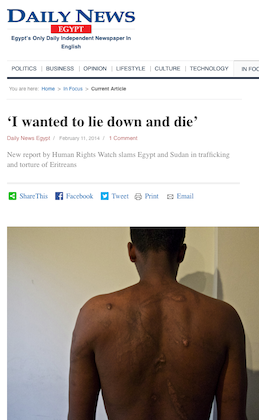
‘I wanted to lie down and die’ (Daily News Egypt)

I wanted to lie down and dieHuman Rights Watch Tuesday released a disturbing report about the ongoing human trafficking and torture in eastern Sudan and Egypt, urging authorities of both countries to finally take effective steps to stop the atrocities. The 79-page report “’I Wanted to Lie Down and Die’: Trafficking and Torture of Eritreans in Sudan and Egypt” documents how for years Egyptian traffickers have tortured Eritreans for ransom in the Sinai Peninsula, including through rape, burning and mutilation. It also documents torture by traffickers in eastern Sudan and 29 incidents in which victims told Human Rights Watch that Sudanese and Egyptian security officers facilitated trafficker abuses rather than arresting them and rescuing their victims. Human Rights Watch speaks of thousands of Eritreans who have been kidnapped and subjected to unbearable violence in the Sinai Peninsula, and the organisation has received new reports as recently as November 2013 and January 2014.

“Egyptian officials have for years denied the horrific abuse of refugees going on under their noses in Sinai,” said Gerry Simpson, senior refugee researcher for Human Rights Watch and author of the report. “Both Egypt and Sudan need to put an end to torture and extortion of Eritreans on their territory, and to prosecute traffickers and any security officials colluding with them.”

Read more …

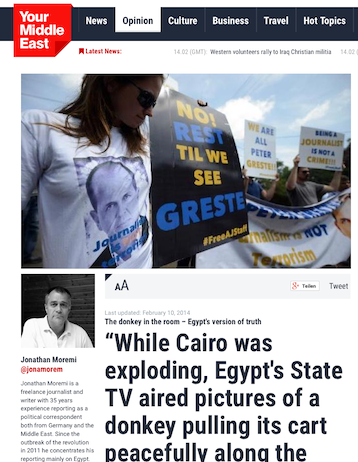
The donkey in the room – Egypt’s version of truth (Your Middle East)

Donkey in the roomEgypt once more has managed to get itself into troubled water. On 29 December 2013 it arrested three journalists from the TV channel Al Jazeera English in their hotel room in Cairo.

The journalists, award-winning Canadian-Egyptian Mohamed Fahmy, who is the bureau chief of Al Jazeera English in Cairo and has worked for CNN and the New York Times, award-winning reporter Peter Greste, an Australian formerly working for the BBC, and the Egyptian producer Baher Mohamed have been held in the notorious Tora prison ever since with both Fahmy and Mohamed subjected to solitary confinement under harshest conditions for weeks.

Only a few days ago were they moved to another ward and now share a cell with their Australian colleague. Fahmy, who suffered a broken shoulder during the arrest in December, has been denied any medical treatment and is yet to see a doctor. Instead, he is being forced to sleep blanketless on the concrete floor. His family filed another request after he was moved, but so far the authorities have not reacted.

Read more …

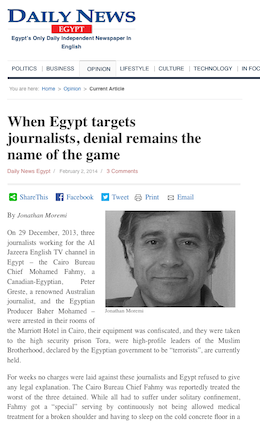
When Egypt targets journalists, denial remains the name of the game (Daily News Egypt)

When Egypt targets journalistsOn 29 December, 2013, three journalists working for the Al Jazeera English TV channel in Egypt – the Cairo Bureau Chief Mohamed Fahmy, a Canadian-Egyptian, Peter Greste, a renowned Australian journalist, and the Egyptian Producer Baher Mohamed – were arrested in their rooms of the Marriott Hotel in Cairo, their equipment was confiscated, and they were taken to the high security prison Tora, were high-profile leaders of the Muslim Brotherhood, declared by the Egyptian government to be “terrorists”, are currently held.

For weeks no charges were laid against these journalists and Egypt refused to give any legal explanation. The Cairo Bureau Chief Fahmy was reportedly treated the worst of the three detained. While all had to suffer under solitary confinement, Fahmy got a “special” serving by continuously not being allowed medical treatment for a broken shoulder and having to sleep on the cold concrete floor in a cockroach-infested cell with no daylight.

Read more …

If you want to know details how the Canadian government of Prime Minister Harper is failing the Canadian-Egyptian citizen Mohamed Fahmy, read my blogpost detailing the incredible telephone conversation with the spokesperson to Canada’s Foreign Minister John Baird:

How the Harper government fails Canadian journalist in Egyptian jail

Read more …


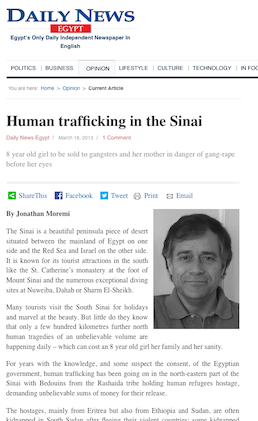
Human trafficking in the Sinai (Daily News Egypt)

Human Trafficking in SinaiThe Sinai is a beautiful peninsula piece of desert situated between the mainland of Egypt on one side and the Red Sea and Israel on the other side. It is known for its tourist attractions in the south like the St. Catherine’s monastery at the foot of Mount Sinai and the numerous exceptional diving sites at Nuweiba, Dahab or Sharm El-Sheikh.

Many tourists visit the South Sinai for holidays and marvel at the beauty. But little do they know that only a few hundred kilometres further north human tragedies of an unbelievable volume are happening daily – which can cost an 8 year old girl her family and her sanity.

Read more …